
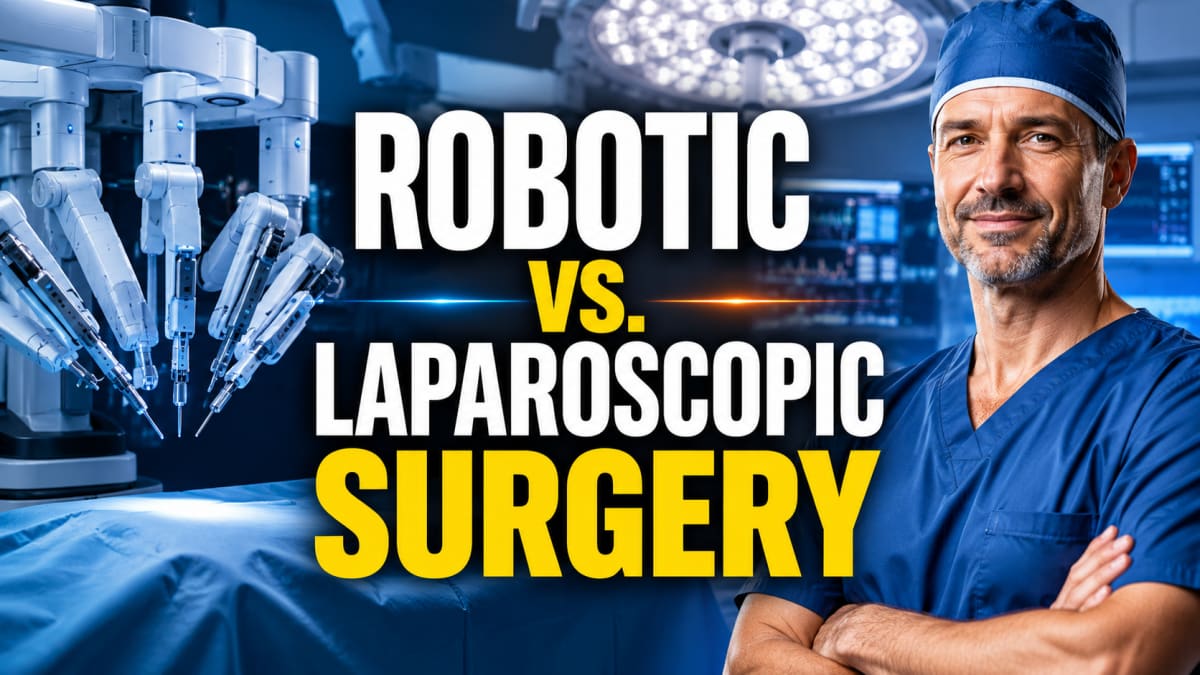
Robotic Surgery vs Traditional Laparoscopy : What Patients Need to Know
When faced with the need for gastrointestinal (GI) surgery, it is natural to have concerns about the procedure and the recovery process. Traditional open surgery, involving large incisions, often meant significant pain and a long road back to normal life. Fortunately, surgical technology has advanced tremendously, offering minimally invasive options that make a big difference. Two prominent approaches are traditional laparoscopy and robotic-assisted surgery. Let’s break down what these are and what they mean for you, the patient.
What is Traditional Laparoscopy?
Traditional laparoscopy, often referred to as "keyhole surgery," was a revolutionary step forward from open surgery. In this technique, the surgeon makes several small incisions, usually less than half an inch long. A small camera (a laparoscope) and specialized, long instruments are inserted through these tiny openings. The surgeon manually controls these instruments while watching a 2D monitor.
While laparoscopy significantly reduced the size of scars and recovery time compared to open surgery, it has its limitations. The surgeon’s movements are somewhat limited by the "fulcrum effect" (working through a pivot point at the incision), and the 2D visualization lacks depth perception.
What is Robotic Surgery?
Robotic surgery is not, as some imagine, a robot performing the surgery. Rather, it is a highly advanced form of minimally invasive surgery where the surgeon is in complete control at all times.
In a robotic procedure, such as one performed using the da Vinci Surgical System, the surgeon sits at a special console in the operating room. From this console, the surgeon views high-definition, 3D, magnified images inside the body. The system translates the surgeon’s hand, wrist, and finger movements with extreme precision into corresponding movements of the micro-instruments inside the patient.
These robotic instruments can rotate much further than the human hand, providing a range of motion that exceeds what even the best laparoscopic surgeon can achieve manually. The system also eliminates any hand tremor.
Key Benefits for Patients: Why Consider Robotics?
While both laparoscopy and robotic surgery are excellent minimally invasive options, robotic-assisted surgery often provides additional advantages:
- Enhanced Precision and Dexterity: The 3D visualization and superior range of motion of the robotic instruments allow for incredibly precise dissection, particularly in tight spaces, such as deep in the pelvis or when operating near critical blood vessels.
- Faster Recovery: Patients undergoing robotic surgery often experience less postoperative pain, less blood loss, and have shorter hospital stays, allowing them to return to their normal activities sooner.
- Less Scarring: Similar to traditional laparoscopy, robotic surgery uses very small incisions, leading to minimal scarring.
- Better Outcomes for Complex Cases: The increased visualization and precision are particularly valuable when treating complex conditions, including certain GI cancers and delicate reconstructive procedures.
When is Robotic Surgery Used in GI Care?
Robotic surgery is now a preferred choice for many complex gastrointestinal conditions, including:
- GI Cancers: Removing tumors of the colon, rectum, esophagus, and pancreas.
- Hernia Repair: Complex ventral or inguinal hernias.
- Esophageal and Stomach Disorders: Treating conditions like severe acid reflux (fundoplication) or achalasia.
Conclusion: Choosing the Right Approach
Both traditional laparoscopy and robotic surgery are valuable tools. The decision of which approach is best for you depends on several factors, including the type of surgery you need, your medical history, and your surgeon’s expertise.
Robotic surgery represents the cutting edge of minimally invasive care, offering patients advanced options for better outcomes and a faster path back to health. If you are facing a potential GI surgery, don't hesitate to ask about the latest techniques available.
Dr. Jayanth H
Surgical Gastroenterologist & Robotic GI Oncosurgeon — MBBS, MS (General Surgery), DrNB (Surgical Gastroenterology), Vattikuti Fellowship in Robotic Surgical Oncology · Bengaluru
Found this helpful? Share it: